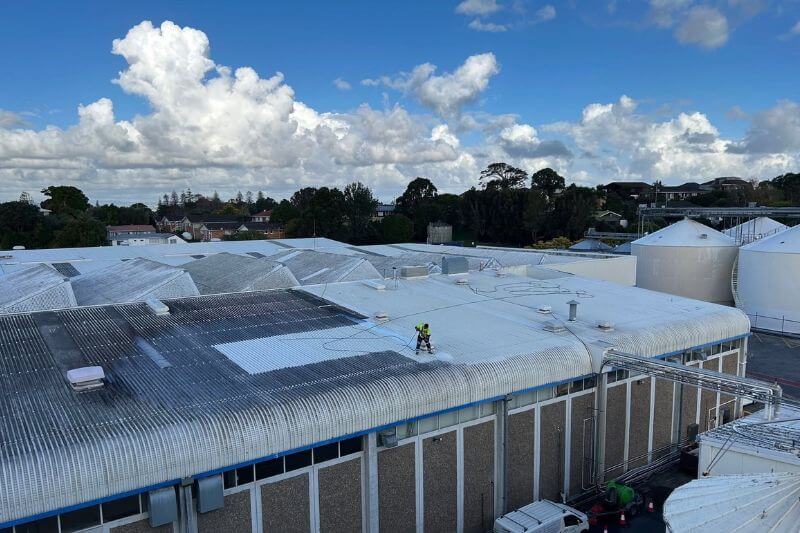
Nobody has ever been promoted for washing a roof.
That’s the honest reason cleaning ends up where it does in most New Zealand facility budgets: parked under housekeeping, reviewed once a year, and first to go when someone needs savings. Maintenance sits elsewhere, attached to the asset register and the capital plan.
The trouble is, the stuff destroying your assets doesn’t care how you’ve filed it. Cut the cleaning line and you have just shortened the life of equipment sitting in your capital forecast. You will find out in about eight years.
In short: Industrial cleaning is preventative maintenance, not presentation. It determines coating life, equipment reliability and whether your product warranties still stand up, which means it belongs in the asset management plan with a frequency, an owner and a paper trail. Not in a discretionary facilities budget.
Why is industrial cleaning maintenance rather than housekeeping?
Because it changes how fast an asset degrades, and housekeeping does not.
Contaminants are not inert. Salt holds moisture against steel. Moss and lichen act like a wet sponge pressed permanently onto a coating. Grease and dust on motors push operating temperatures up, a quiet tax on every bearing and seal in the plant. Bird droppings sit around pH 3 to 4.5, and sustained exposure under a roosting site strips coatings and corrodes the steel beneath, which is why bird proofing is an asset decision rather than an aesthetic one.
Each of those has a rate. Cleaning slows the rate. That is the entire definition of preventative maintenance, whichever cost centre writes the cheque.
What does skipping the clean actually cost you later?
It costs you capital replacement years ahead of schedule, which is almost never traced back to the decision that caused it.
Nothing fails dramatically. There is no incident report, no moment where someone says “this happened because we stopped washing the cladding in 2021”. A coated roof quietly uses up its life faster than the spec sheet promised, and the replacement lands in a budget nobody expected to spend.
Where the money actually goes:
- Recoating or replacing roofing and cladding ahead of plan
- Unplanned stoppages when fouled equipment runs hot and fails
- Emergency callout rates instead of scheduled rates
- Access equipment hired at two days’ notice rather than booked into a cycle
- Substrate repairs, once corrosion has gone past the surface and into the steel
None of that appears in a cleaning budget. All of it is caused by the absence of one.
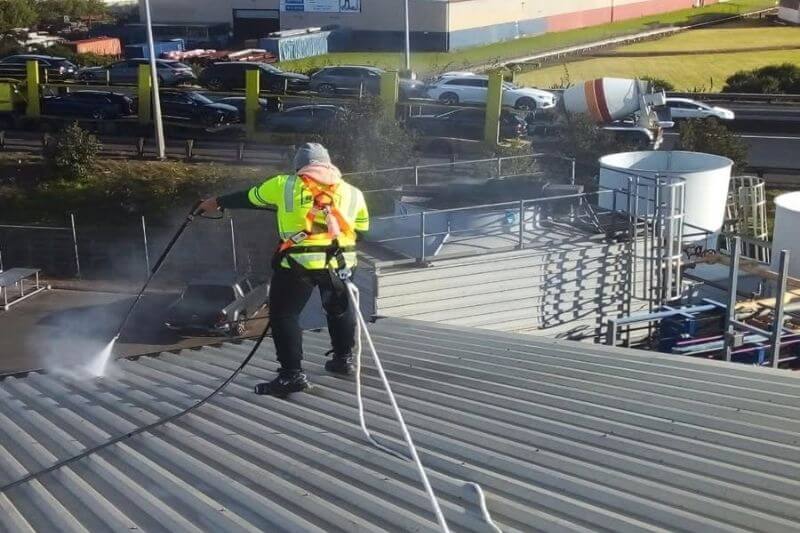
Which assets fall over first when cleaning gets cut?
Anything that holds moisture, sits out of the rain, or runs hot.
Roofs and cladding. The most valuable asset on most sites and the least inspected, because getting up there is a job. Here’s the counterintuitive part: sheltered areas degrade faster than exposed ones. Under eaves, behind flashings, anywhere rain can’t reach. Rain does a surprising amount of your maintenance for free, and the bits it misses are the bits that bite.
Plant rooms. Dust and grease on motors, fans and heat exchangers. Heat is the enemy of everything mechanical, and insulation is exactly what a layer of grime provides.
Structural steel and facades. Particularly at ground level, where splash, traffic film and organic growth all concentrate.
Gutters, downpipes and sumps. Blockages cause water ingress, and water ingress damages structure, insulation and stock, usually at 2am on a Saturday.
Does your roof warranty actually require you to wash it?
Almost certainly yes, and more often than you think.
New Zealand pre-painted steel warranties set washing frequency by environmental category, and compliance is a condition of cover rather than a friendly suggestion. ColorCote publishes manual washing intervals running from every 12 months down to every three months depending on the zone and the surface. COLORSTEEL sets out equivalent schedules against warranties of up to 50 years, with category boundaries drawn at distances from the coast that catch far more New Zealand industrial sites than most owners assume.
So, your required frequency is probably higher than your actual one, especially within five kilometres of the coast. And you need a record. A claim on a nineteen-year-old roof comes down to whether you can evidence maintenance. A dated invoice with a scope on it is that evidence. A vague sense that someone washed it is not.
Go and find your warranty documentation. Actually, go and find it. Most facility managers have never read the maintenance schedule attached to the most expensive surface on their site.
What does cleaning look like inside an asset management plan?
Like any other planned task: asset, activity, frequency, responsible party, record.
| Reactive cleaning | Planned schedule | |
| Trigger | Complaint, failure or audit | Calendar and condition |
| Rate paid | Emergency or callout | Scheduled contract rate |
| Access | Hired at short notice | Planned, shared across tasks |
| Downtime | Unplanned, mid-production | Booked into shutdown windows |
| Asset life | Reduced, unpredictably | Meets or beats specification |
| Warranty position | Hard to evidence | Documented and defensible |
| Budget treatment | Variable, unforecastable | Fixed, forecastable |
Set frequency by exposure rather than by habit. A site in Lyttelton and a site in Auckland with identical roofing do not need the same cycle, and treating them the same is how one of them ends up corroded.
Group anything that shares access. If you’re putting people on the roof, do the wash, the gutters and a high-level inspection in one visit rather than paying for the same access three times. Our building maintenance and moss and mould treatment work is scoped this way.
Spring is the sensible time to sort it. You’re through the wettest of the growth season and ahead of the summer shutdown windows. Leave it until January and you’ll be competing with everyone else who left it until January.
Where does this usually go wrong?
A roof gets washed occasionally, when it starts to look bad from the ground. No schedule, no owner, and the invoices aren’t kept anywhere findable. For years nothing appears to be wrong, because from ground level nothing is.
When someone finally gets up there, the corrosion isn’t on the open expanses visible from below. It’s under the eaves and around sheltered flashing details, the shaded awkward areas rain never touches and the warranty specifies most strictly. By then the roof can be a decade into a warranty that assumed a far shorter interval than it was getting.
The roof is rarely the real problem. The real problem is that nobody looked, and nobody could prove anything. Both are fixed by treating the clean as maintenance rather than a tidy-up, and a clean generates information as well as removing grime, as we covered in what industrial cleaning reveals about hidden risks in your facility.

Talk to us about building cleaning into your maintenance plan
Rapid Facility Services helps asset managers across New Zealand set cleaning frequencies that match real exposure, warranty conditions and shutdown windows, rather than whatever the last person happened to do.
From pressure washing and gutter clearing to grounds maintenance, we make sure your facility is ready to shine for spring and summer.
Our directors have years of experience in the food manufacturing sector alongside industrial cleaning and building maintenance, so we tend to look at a site the way an operator does rather than a contractor. PREQUAL certified teams, Auckland and Christchurch branches, nationwide coverage, available 24/7 every day of the year.
Call 0800 372 743 or book a site visit for a free estimate. We’ll tell you what we’d schedule and why, and you can take that straight into your plan.
We will do whatever others can’t or won’t do. Including getting into the bits of your roof nobody has looked at since it went on.
Frequently asked questions
Is industrial cleaning a capital or operating expense?
Operating, almost always. But it protects capital assets, which is why it belongs in the asset management plan even though it’s paid out of opex. Classifying it as maintenance rather than housekeeping is largely what stops it being cut.
How often should a commercial roof be washed in New Zealand?
It depends on your environmental zone and coating product. Schedules range from rain washing alone in mild inland areas to manual washing every three months in very severe coastal or industrial zones, with sheltered areas needing more attention than exposed ones. Check your product documentation rather than guessing.
Can poor cleaning records affect a warranty claim?
Yes. Coating warranties in New Zealand commonly make maintenance compliance a condition of cover. Dated invoices showing scope and frequency are the simplest evidence you can hold, and they cost nothing to keep.
Will this interrupt production?
It shouldn’t. Most industrial cleaning is planned into shutdown windows, nights or weekends. Working around your operation is standard, not a special request.