You booked a clean. The crew arrived, got partway through, and then stopped. Something wasn’t available, or an area couldn’t be accessed, or the job turned out to need gear nobody had brought. They’ll be back next week.
Meanwhile, you’ve shut down a line twice, rescheduled your own people twice, and paid for access equipment that sat idle for an afternoon.
The difference between a one-visit job and a three-visit job is almost never the cleaning itself. It’s what happened before anyone turned up.
In short: A successful industrial cleaning job starts well before the team arrives on site. Equipment, chemicals, PPE, hoses, parts, and specialist products must be available and fit for purpose; access requirements must be confirmed rather than assumed; and the crew must know the plan before they start. When that groundwork is missing, the cost lands on your production schedule, not the contractor’s.
What happens before an industrial cleaning team arrives on site?
The preparation determines whether the job runs to plan. Equipment must be available and fit for purpose, consumables must be in stock, and the method must suit the surfaces and contamination actually present on your site.
That sounds obvious until you consider how much variation there is between jobs. A silo, a production line, a roof, and a plant room each need different equipment, access, chemicals, and safety controls. A contractor who treats them as broadly similar will discover the differences on your time.
A lot happens behind the scenes to make sure teams are ready to do the job properly. None of it is visible to you, which is exactly why it’s worth asking about.
Why does product and equipment availability affect your downtime?
Because a crew that runs out mid-job can’t finish it, and the second visit costs you another shutdown.
This is where supplier relationships matter more than most people would guess. Having the right products, technical support and equipment available when they’re needed is what keeps a job moving and lets a team respond when a site turns out to be different from the brief. A contractor without that backing has to wait for stock, and you wait with them.
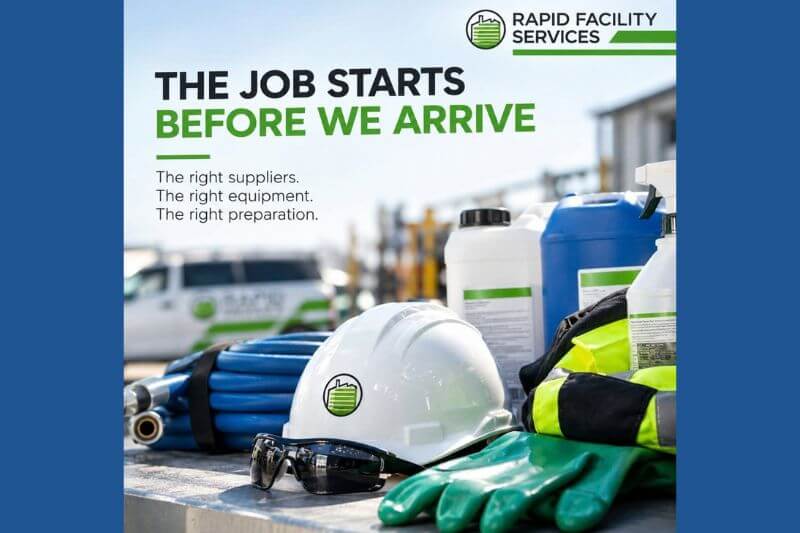
What needs to be sorted before the truck leaves:
- The specific chemicals for your surfaces and contamination, in sufficient quantity
- PPE appropriate to the hazards on your site
- Hoses, fittings and spare parts for the equipment being used
- Specialist products for anything non-standard
- A backup plan when a site presents something unexpected
Chemical choice is its own discipline, and we’ve covered it separately in why the right cleaning solution matters. The point here is narrower: having the right product on the truck is a different problem from knowing which product to use, and both have to be solved before anyone arrives.
What should a contractor confirm before quoting, not after?
Everything that could change the method, the access or the time required. The questions are not complicated, but they have to be asked before the quote, not discovered on the day.
The process depends on the business activity being carried out and the machinery, products and chemicals involved. No two spaces are the same, so a quote built on assumptions tends to change once the crew is in the room.
Industrial equipment takes a lot of punishment during day-to-day production, so the cleaning process has to take the equipment itself into account. The wrong chemical can cause corrosion, affect coatings, or deteriorate certain surfaces over time. Working that out requires knowing what the equipment is, what it’s made of, and what has actually built up on it.
The same applies to access. Whether a job needs a platform, whether areas need isolating, whether a space is confined, whether production has to stop and for how long. A contractor who confirms this upfront gives you a quote you can plan around. One who doesn’t gives you an estimate that changes once they see the site.
Why does operator certification matter for access equipment?
Because an uncertified operator can’t safely or legally run the machine, and your job stops while someone finds one who can.
Some industrial cleaning jobs take teams well above ground level, so safety has to be part of the job from the beginning. Training in Mobile Elevated Work Platforms covers the equipment, the environment and the risks involved in working at height, and our teams are trained and experienced working both at heights and in confined spaces. That training is what gives a team the confidence to do the job safely and properly rather than cautiously and slowly.
It matters commercially and legally. Working at height is one of WorkSafe New Zealand’s priority topics, and a contractor whose crew isn’t current on the equipment is a contractor who will either decline the work or do it badly. We’ve written before about the hidden risks of high-level industrial cleaning and why overhead areas need specific attention.
Worth asking any contractor: who on the crew is certified, on which equipment, and when does it expire?
What is a toolbox meeting actually for?
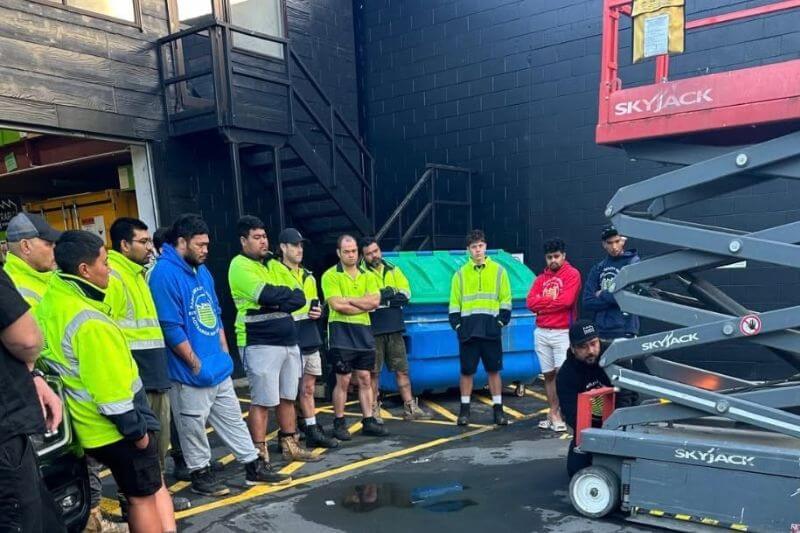
It’s where a crew agrees on the plan, which is what stops them improvising on your site.
A toolbox meeting should be more than a quick gathering before everyone heads off. In industrial cleaning the work changes from site to site and job to job, so the meeting is where the team talks through the work ahead, identifies anything that could create a risk, clarifies who is responsible for what, and makes sure everyone understands how the job will be approached.
It’s also where people raise concerns and share what they learned on previous jobs. In environments where access, equipment, chemicals, working at height and other site hazards all come into play, a few minutes of the right conversation makes a real difference.
From your side of the fence, this is the difference between a crew that knows the plan and a crew working it out as they go. One finishes on schedule. The other asks you questions all morning.
What does a one-visit job look like compared to a three-visit one?
The difference shows up in the scoping, not the scrubbing.
| Three-visit job | One-visit job | |
| Site information | Gathered on the day | Confirmed before quoting |
| Equipment | Whatever was on the truck | Matched to surfaces and access |
| Products | Discovered to be short | Scoped and stocked beforehand |
| Access | Worked out on arrival | Agreed, isolated and booked |
| Certification | Checked when it becomes a problem | Confirmed at scoping |
| Your shutdown | Repeated | Used once |
| Your cost | Expands | Holds to quote |
The pattern behind most repeat visits is the same. Something that could have been established in a ten minute conversation was instead found out at nine o’clock on a Tuesday with a line already stopped. We looked at the broader cost of this in how poor industrial cleaning leads to costly downtime.
Talk to us before the shutdown, not during it
Rapid Facility Services scopes industrial cleaning work properly before quoting, so the job that gets booked is the job that gets done. Our PREQUAL certified teams work from branches in Auckland and Christchurch, nationwide, and we’re available 24 hours a day, every day of the year, including public holidays.
If you’ve had jobs run over, call 0800 372 743 or get in touch for a site visit and a free estimate. We’ll tell you what the job actually needs before you commit to anything.
We will do whatever others can’t or won’t do. We’d just rather do it once, and do it right.
Frequently asked questions
What should I ask an industrial cleaning contractor before booking?
Ask what they need to confirm on site before quoting, what certifications the crew holds for any access equipment, and what happens if the job turns out to be different from the brief. The answers tell you whether you are getting a quote or an estimate.
Why do cleaning quotes change once work starts?
Usually because the scoping was incomplete. Surfaces, contamination type, access requirements and isolation needs all affect method and duration, and if they were not established upfront they get established mid-job.
Can industrial cleaning be done without stopping production?
Often, yes. Industrial cleaning is routinely planned into shutdown windows, nights or weekends. What matters is that the scheduling is agreed during scoping rather than negotiated on the day.
How do I know a contractor’s safety systems are real?
Ask to see them. Certification, training records and a documented approach to site hazards should be available on request, and our own health and safety approach is published for exactly that reason.